Touching as a unique source of knowledge
Marloeke van der Vlugt is the first person to obtain a PhD in artistic research through the partnership between HKU and UvH
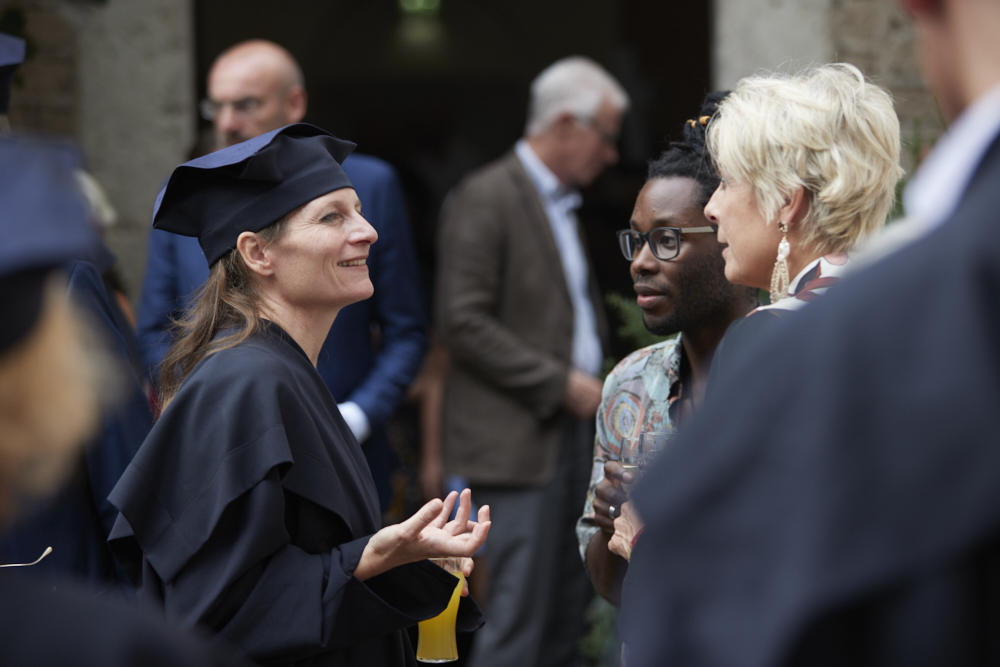
If touching forms the starting point for art rather than seeing and hearing, this creates space for other forms of knowledge and understanding. This is demonstrated by Marloeke van der Vlugt of the HKU University of the Arts in her thesis Touching (the) Strangeness – Exploring Touching as methodology in artistic research, which she defended on 19 May at the University of Humanistic Studies.
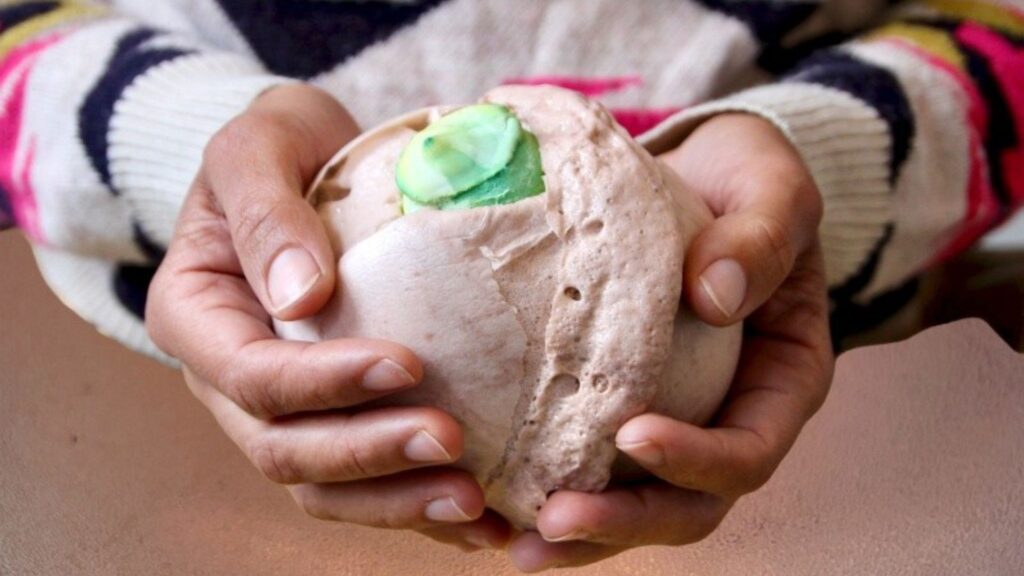
Artist and HKU lecturer Marloeke van der Vlugt is the first researcher to obtain a PhD through the partnership between HKU and UvH, Meaningful Artistic Research, which enables students to pursue an academic PhD programme in artistic research. Her artistic research project focuses on the question: What happens when art is not only viewed, but also touched?
The impact of Touching
Marloeke: “The sense of touching is one of the most important senses we are born with. But whilst as babies we still grab everything and put it in our mouths, we are very quickly taught not to do so. ‘Don’t touch’ is a phrase we hear often in our earliest years. In the arts, too, aesthetic distance is promoted, and looking and listening have taken on a much more prominent role. In museums, everything is neatly displayed in a glass case, and at performances the audience sits at a respectful distance from the performers. And yet there is hardly any experience more direct and impactful than touching.”
Through her art projects and research, Van der Vlugt draws renewed attention to the act of touching, not only for her audience but also for herself as an artist: “How do I touch this world, and how does the world touch me?” In recent years, she has organised and explored various art installations and projects, both independently and in collaboration with others, constantly alternating and combining her roles as an artist, teacher and researcher.
Touching (the) strangeness
The exploration of the concept of ‘Touching (the) Strangeness’ remained central throughout. “By ‘strangeness’, I mean the experience that the body sometimes follows its own course – unpredictable, not entirely controllable, moving beyond the will. These are signs that the body possesses its own knowledge. Phenomenologically, this ties in with the lived body that sometimes makes us feel like ‘the other’; biologically, it resonates with the autonomic nervous system that constantly adjusts our behaviour, often beyond our conscious will. What happens if, instead of suppressing those movements, you observe them and explore what is released in that unpredictability?”
At a time when touching is associated with risk and taboo, Marloeke is, in fact, seeking ways to activate tactile sensations. Ultimately, in her thesis, she does not ask what Touching means, but what Touching can do: how it recalibrates sensory attention, resists the reduction of touching to risk or taboo, and opens up pathways for embodied research in art, education and care ethics practices.
Exhibition at Landhuis Oud Amelisweerd
Following the PhD defence, the exhibition Touching (the) Strangeness opened at Oud Amelisweerd Country House. It showcases a selection of the experiments Marloeke developed during her research. The exhibition unfolds as a relational, time-bound, embodied art practice, in which questions surrounding care and ethics play a part. The exhibition is open until 14 June.
Marloeke van der Vlugt
Artist and HKU lecturer Marloeke van der Vlugt (1971) graduated cum laude in 1997 from the Theatre Studies programme at the University of Amsterdam with an artistic research project exploring the relationship between costume, scenography, video and movement. In 2019, Marloeke embarked on a new phase in her artistic career: her artistic PhD research at the intersection of Visual Arts, Performance and Scenography, which explores our aesthetic interaction with materialities (bodies, objects, spaces) through the lens of touching.
Read more on her artistic projects on the website of the HKU.