
Henk den Uijl: ‘Moral responsibility always goes hand in hand with a certain risk’
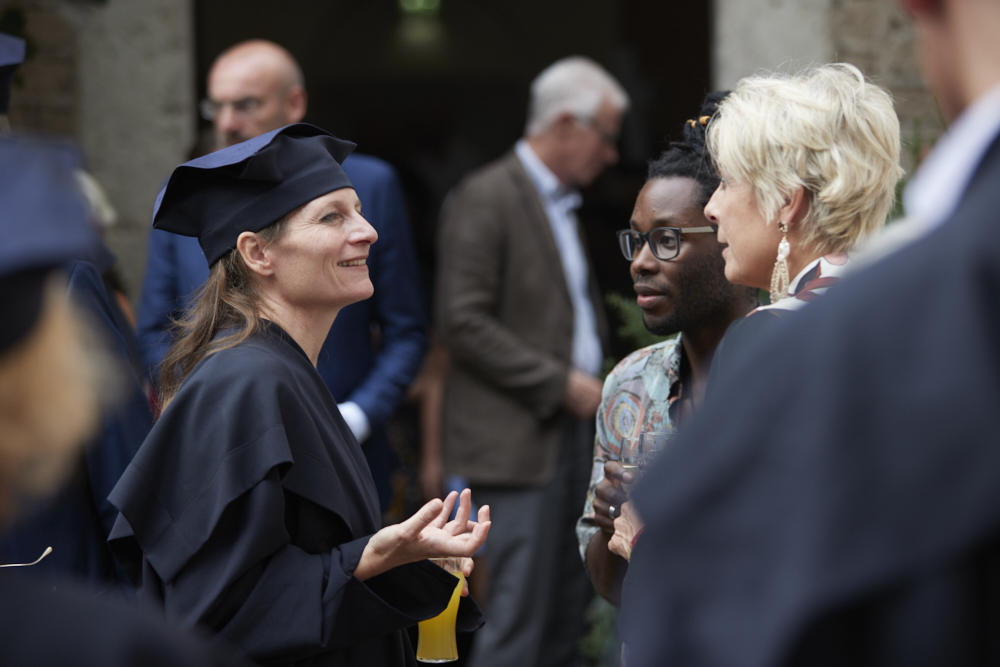
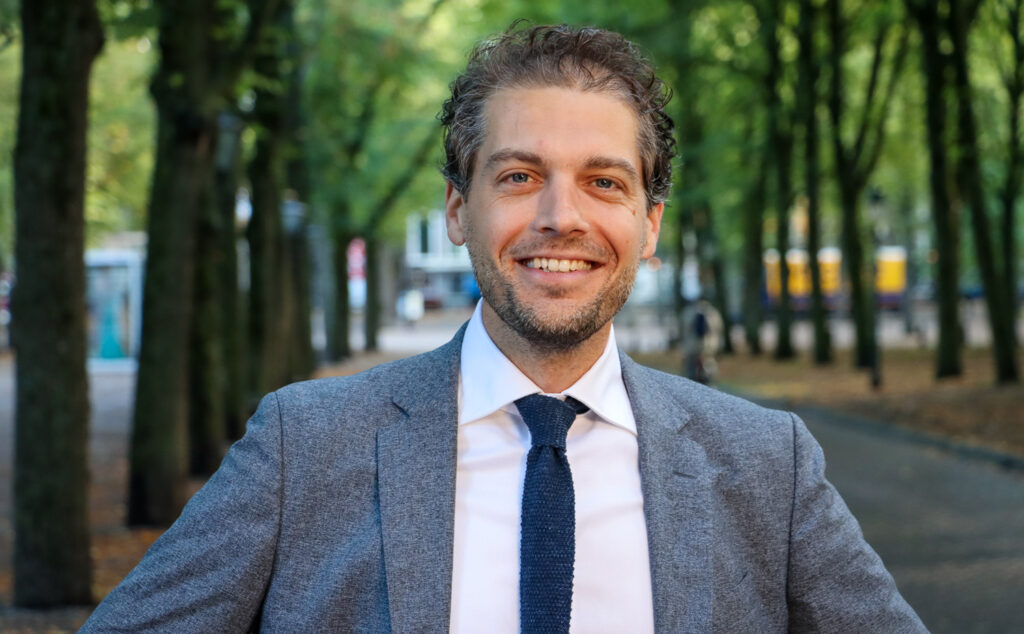
On 16 October, Prof. Dr Henk den Uijl, Professor by Special Appointment of Philosophy of Governance and Policy, delivered his inaugural lecture. His chair at the UvH was established by the Netherlands School of Public Administration.
What is your inaugural lecture about, in a nutshell?
“It is about how administrators, policymakers and civil servants can still bear moral responsibility in times of uncertainty and powerlessness. Our institutions have become large and complex, and we feel that we are becoming bogged down in bureaucracy. Is it still possible, then, to be responsible for matters over which you have little control? I argue that it is possible, but only if you are prepared to take risks. Sometimes this means opposing a law, a rule or an administrative practice, based on what you see happening in a specific situation.”
The title of your inaugural lecture is ‘To take the Leap’. What do you mean by that?
“By ‘to take the leap’, I mean taking responsibility for something and putting something on the line for it. Moral responsibility always goes hand in hand with a certain risk. You don’t get bogged down in fine words, control and risk management, nor do you lose yourself in endless doubt. It essentially boils down to learning once again to value and use your judgement in specific situations. In an administrative context, this means, amongst other things: recognising that the law and policy are not all-powerful or all-knowing, and accepting the consequences that follow from that.”
You often refer to Hamlet, Shakespeare’s famous play. What can Hamlet and Polonius teach us?
“They illustrate two ways in which responsibility can go wrong. Polonius, the king’s adviser, rattles off one fine piece of wisdom after another. You could easily translate them into modern administrative language: ‘be transparent’, ‘follow your moral compass’, ‘act in good faith’. But in the meantime, the only thing he is actually doing is perpetuating espionage, surveillance and control. Above all, he wants everything to remain predictable and for people to toe the line. He uses morality to keep the system intact. Modern governance does much the same: it talks a lot about values, whilst nothing changes and few risks are taken.
With Hamlet, it is the other way round. His reflection is sincere and profound, but it paralyses him. He doubts the meaning of his actions, what he can know, and his own motives. As a result, he keeps putting things off, until circumstances force him to act impulsively. We see this in government too: a decision that is continually postponed because common ground, let alone compromise, is scarcely possible any longer in politics and society. But reality imposes itself on us sooner or later.
Neither takes any risks and, as a result, ultimately bears no responsibility. The challenge is to embrace Hamlet’s honest reflection without becoming paralysed, and not to use Polonius’s moralising as a fig leaf.”
Why is it important to reflect on this right now?
“Hamlet exclaims: ‘The time is out of joint’. It is not difficult to see the parallel with our own times. There is menace, fear and discontent. The government is almost impossible to fathom. We feel like pawns in the hands of international superpowers and brutality. At the same time, moral rhetoric – about ‘intention’, ‘courage’ and ‘leadership’ – has become dominant in administrative circles. There is something beautiful about this, but it is also non-committal and can become a form of self-justification. And because nobody can disagree with such lofty moral principles – and so no one is willing to take risks – change and hope are stifled.
Furthermore, we are increasingly looking to laws, rules, compliance and oversight for solutions. This gives abstract rules a moral scope that they cannot live up to in specific cases. This can take on totalitarian characteristics. Disobedience as a corrective mechanism is a cornerstone of democracy, as Rawls, Schuyt and Ricoeur demonstrate. Anyone who takes away that space or makes it impossible to exercise displays a totalitarian tendency. Disobedience is now more often treated with suspicion and curtailed – for example, in the context of protests and demonstrations – rather than being afforded space to take place. This is extremely worrying.”
Could you give an example?
“I’ll give two from my research practice. The first concerns two school boards that wish to stop using the legally required progression test at a number of schools. The test is intended to promote equality of opportunity, and there is evidence to support this. In practice, however, the schools are also seeing the opposite effects: perverse incentives to focus on test scores, and stress and pressure on the children. They are developing their own pedagogical vision and quality system and have decided, in consultation with parents, to abolish the test. The stakes are high. The sector is in turmoil, and the Ministry and the Inspectorate are threatening to issue an emergency directive labelling the schools’ actions as mismanagement. This constitutes civil disobedience in the pursuit of a public good, justified in a way that is recognisable and understandable to parents and other members of the public.
The second concerns civil servants from the Ministry of Foreign Affairs and other departments who meet every Thursday at lunchtime outside the ministry. They are asking whether, on the basis of Article 90 of the Constitution, the Netherlands ought not to take a stand against the way in which Israel oppresses the Palestinians. They are taking a great risk, both to their careers and to the relationship between politics and the civil service. The protesters base their arguments primarily on legal grounds and invoke the fundamental principles of the government itself, rather than personal political views. In this way, they demonstrate that, as a civil servant, one can reason on moral grounds whilst remaining loyal.
In both cases, moral reasoning is applied, but with consequences and risks. They avoid the fate of Polonius, and that of Hamlet too: they do not resign themselves to a system that may produce unjust or ambivalent outcomes.
Both cases also demonstrate how laws and regulations can take on totalitarian traits in modern administrative culture. This occurs through a Polonius-like self-justification: the model is sound, after all; it has been decided, after all; it has been calculated, after all. Such an attitude renders disobedience suspect from the outset, as it stands in the way of objectivity and unambiguity. Meanwhile, a power is being exercised that seems to take the very breath out of society.”
Why must we also be wary of an overdose of ethics?
“I have two comments to make on this. Firstly, ethics – certainly when it is overly lofty – can get in the way of understanding what is actually going on. Bringing morality into the picture too quickly can itself be a form of manipulation or overconfidence. To paraphrase Foucault: if everything is ethics, then nothing is ethics. Often, you’re simply doing your job. Otherwise, you pour an ethical veneer over everything, and the legitimacy of your actions is automatically guaranteed. That is the fate of Polonius.
Secondly: those who always wish to do good do not automatically act in a morally responsible manner. In this respect, I follow Machiavelli. He writes that those who seek to do good in all circumstances will be overwhelmed by the many who do not. This is not a plea for malice. For Machiavelli, the issue is not whether you can look at yourself in the mirror, but what your actions bring about in the world. Responsibility in politics is judged by the consequences, not by the purity of your intentions.
Sometimes it is tempting to do something good that is nevertheless politically problematic. Take the tendency to provide financial compensation for every form of misfortune. This seems morally self-evident, but leads to major administrative problems, as Pieter Hasekamp of the CPB warns regarding the ‘compensation society’. Sometimes, therefore, responsible governance requires you to say ‘no’ to something that appears morally right. Anyone who always wants to be morally right ends up like Hamlet: paralysed, and no longer capable of thinking politically or taking responsibility.”
About Henk den Uijl
Prof. Dr Henk den Uijl is a professor by special appointment in the Philosophy of Governance and Policy at the University of Humanistic Studies. He is co-dean, lecturer and researcher at the Netherlands School of Public Administration (NSOB) and publishes extensively in the fields of governance, philosophy and oversight. He is a member of the supervisory board of the JP van den Bent Foundation (care for people with disabilities), editor of the Filosofie-Tijdschrift and a columnist for the Nederlands Dagblad.