

“Art-Based Communities” promote social justice for people with intellectual disabilities
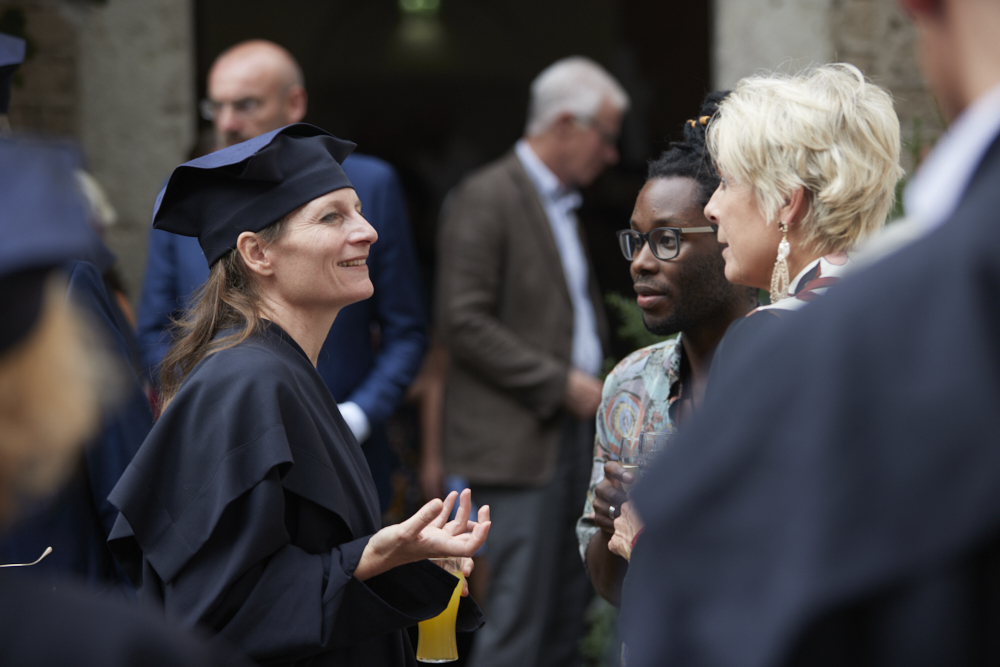
Groups in which people with and without intellectual disabilities create art together – known as art-based communities – are a valuable contribution to the discourse on social justice in our society, according to PhD candidate Anja Zimmermann. Today she is defending her doctoral thesis at the University of Humanistic Studies.
What does it mean to belong? To be recognised, to have influence, and to participate in society in your own way? For people with intellectual disabilities, this is not a given. In her PhD research, Anja Zimmermann investigated how art-based communities – communities in which people create art together and meet one another – can provide a space for social justice.
Social justice is about more than just equal rights and formal opportunities. It is also about the day-to-day relationships between people: who is seen and recognised? Whose experiences and knowledge are taken seriously? And who has a say in what happens?
Making art together
For her research, Anja Zimmermann examined the significance of art-based communities for people with intellectual disabilities. She carried out various sub-studies, including a literature review and research into the history of the social position of people with intellectual disabilities.
In addition, she carried out field research at five art communities in the Netherlands and Germany, where people with and without intellectual disabilities created art together. In these communities, alternative ways of communicating and participating can become visible. Meaning is expressed not only through words, but also through images, gestures, movements, materials and silences. It is precisely through the collaborative creative process that experiences and perspectives can come to the fore which might otherwise go unnoticed.
Recognition, participation and a sense of belonging
In her research, Anja identifies three interrelated dimensions of social justice: recognition, participation and belonging. Recognition means that people are taken seriously for who they are and in the ways in which they express their experiences and knowledge. Participation goes beyond simply being present somewhere or choosing from a set of predetermined options. It requires people to have a genuine say and to be able to help shape what happens. Belonging means that people can be part of a community without their disability or need for support defining their identity or their relationships with others.
Creating space
According to Anja, the significance of art-based communities also lies in the opportunity they offer to challenge existing ideas and relationships whilst creating together. Who decides what art is? Who decides where and how someone is allowed to take part? And who is given the space to make sense of what is happening?
These questions touch on the role of professionals and organisations. Power imbalances also exist within creative practices. For example, professionals have an influence on how activities are structured and on the interpretation of what participants create. Good intentions are not enough to foster relationships of equality. It requires constant attention to examine one’s own influence and to allow space for other perspectives.
That is why art-based communities are not automatically inclusive or equitable spaces. Their significance stems from the way in which people shape the community together and from the scope there is for everyone to contribute. The connection with wider society is also important.
Implications for practice
The insights from the research are relevant to professionals and organisations working in the care of people with intellectual disabilities, in education and in the social sector. They encourage us to take a critical look at the assumptions we take for granted in our own practice. Who is given the opportunity to get involved? Who decides what constitutes a valuable contribution? And how can people with intellectual disabilities have a real say in the communities of which they are a part?
In her PhD research, Anja Zimmermann links the practice of art therapy and art communities to broader questions of social justice. Her research invites us to take a different look at what people can contribute and at the space we allow one another to shape, together, the world in which we live.
PhD Defence Anja Zimmermann, 16 November, Bridging Clinical Art Therapy and Social Justice-Oriented Art-Based Communities; Art Therapy as a Healing and Emancipatory Space for Persons with Intellectual Disabilities.
Anja Zimmermann is an art therapist, lecturer and researcher at the Arnhem and Nijmegen University of Applied Sciences.