
Public leaders’ time for reflection is under pressure
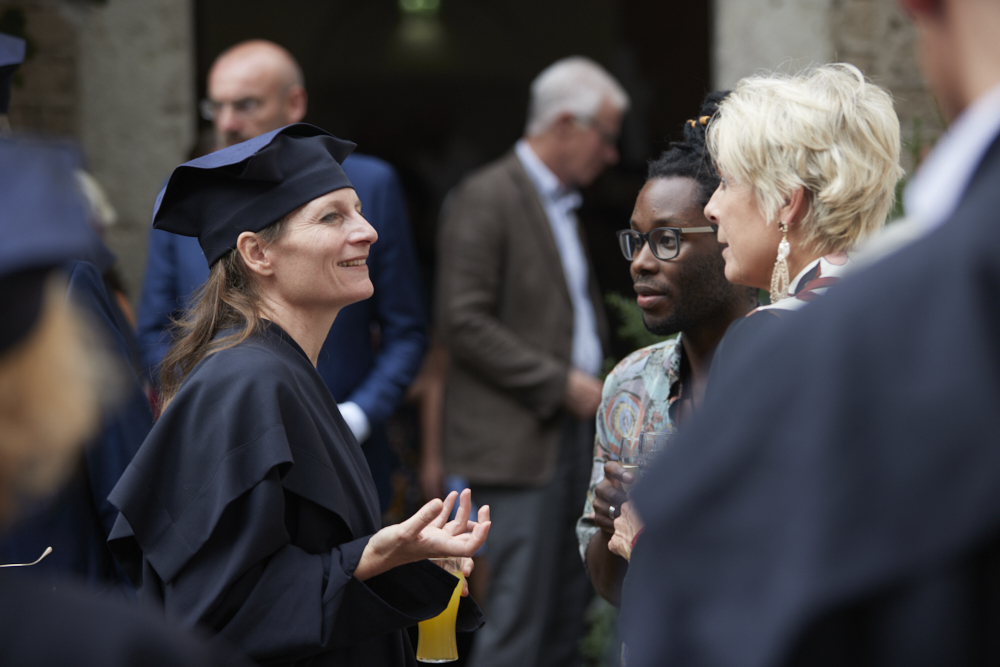
Public leaders in education, healthcare, government and other social organisations are finding they have less and less opportunity for reflection, even as their need for it is actually growing. Moreover, it appears that the idea of reflection primarily evokes a socially desirable dynamic. This is the finding of research by occupational and organisational psychologist Barbara van der Steen, who defended her thesis at the University of Humanistic Studies on 24 November.

For her doctoral thesis, Always switched on: Exploring reflectivity among public leaders in accelerated times, Barbara van der Steen interviewed 31 public leaders about their day-to-day work. Her qualitative study shows how public leaders constantly balance the pressure to act decisively with the need to reflect on complex issues, uncertainties and moral dilemmas.
Socially desirable
Both within organisations and in society at large, high expectations are placed on the actions of directors, whilst work processes are accelerating. Van der Steen has been following this development for years in her work as a consultant to executives, management teams and boards of directors. “Managers say they need time for reflection,” says Van der Steen. “It is precisely in complex situations that they realise how important it is to take time to consider questions, doubts and uncertainties.”
But the idea of reflection primarily evokes a dynamic that is highly socially desirable. Van der Steen: “Everyone emphasises its importance. Yet, at the same time, there is little critical examination of what reflection actually means and what it requires.” That is why she delved deeper into the practical experiences of managers. In practice, it turns out to be considerably more challenging than many theories on reflection and leadership suggest.
Three obstacles
The research identified three recurring obstacles.
- Board members find that open reflection is difficult due to the asymmetrical relationships they have with staff, management teams and other stakeholders. The challenge here lies not so much in the substance of the issues, but primarily in the relational dynamics. Board members wonder how much scope there really is to show vulnerability, doubt and uncertainty.
- They feel a great deal of pressure to act decisively, clearly and swiftly. They say that those around them expect answers and decisions. In their view, any delay is quickly seen as indecision, whilst it is precisely that delay that is sometimes needed to properly understand complex issues.
- Reflection is often used as a tool within organisations. Appraisals, retreats and informal discussions are usually focused on concrete outcomes and quick results. There seems to be less room for the uncertainty, the unexpected or the discomfort that can accompany in-depth reflection.
In addition, many managers say they prefer not to cause a stir in their teams by speaking openly about feelings of confusion, perplexity, intuition or emotion.
Resonance
Behind the desire for more space for reflection lies, for managers, a deeper longing for what the German sociologist Hartmut Rosa calls ‘resonance’: experiences in which people are moved and feel connected to others, their work or a social cause, as this study revealed. According to the participants, this longing is at odds with a working environment that is heavily focused on efficiency, measurability and constant acceleration.
Many public leaders recognise the idea that people are not only rational beings, but also emotional, relational and resonant beings who transform one another. It is precisely this dimension that they perceive as vulnerable in a working environment where performance, accountability and a focus on results take centre stage.
Delay
Van der Steen: “I suspect that leaders are not the only ones struggling with the pace and pressure to perform. Their colleagues, too, often seem to feel trapped in a generally accepted cycle of measuring, evaluating, substantiating and justifying.”
She advocates a more inquisitive and reflective approach, one that creates space for sharing questions, doubts and uncertainties. “It is precisely when the outcome is not yet certain that new insights can emerge. Reflection requires the courage not to immediately brush aside any discomfort, but to take the time to listen carefully first. Such a pause is not a luxury, particularly given the issues we face today.”
Barbara van der Steen is an occupational and organisational psychologist and has been advising management teams, directors and managers in organisations for over 25 years.