

Pieter Dronkers on the silent struggle for Jerusalem
In his new book De stille strijd om Jeruzalem (‘The Silent Struggle for Jerusalem’), lecturer and researcher Pieter Dronkers writes about the resistance of Palestinians and Jewish Israelis to Israel’s policies of occupation and colonisation in and around East Jerusalem. “This struggle also offers lessons for resistance against authoritarian politics elsewhere in the world.” A book launch will take place in Amsterdam on 6 October.
What is your book about?
“In 1967, Israel occupied the Old City of Jerusalem and the surrounding neighbourhoods. Since then, the Palestinian residents have been under constant pressure to leave this area. Neighbourhoods are being neglected, people are losing their homes, and settler organisations are given free rein. Step by step, the historical, cultural and religious ties between Palestinians and the city are being severed. Palestinian Jerusalemites are resisting the loss of their homes and history in all sorts of ways, supported by Jewish activists. The book highlights this resistance and shows how the public space for criticism is shrinking.”
What prompted you to carry out your research?
“Since 7 October 2023, Israel and Palestine have been a source of division in Dutch society more than ever before. At the University of Humanistic Studies, too, there has been much discussion on the subject in recent years. Some students and colleagues took action, whilst others chose not to take a stance. As a researcher, I have been visiting Jerusalem for years and I wanted to share the stories and experiences of the people I have worked with. I sometimes find the debates lack nuance; at the same time, the complexity of the situation must not be used as an excuse to simply stand on the sidelines.”
The concept of ‘silencing’ plays an important role in your book. What do you mean by that?
“There are an increasing number of authoritarian rulers who are silencing critical voices. Not only in Israel and Palestine, but also in all sorts of other places around the world. That is why I wanted to investigate the various ways in which this process of ‘silencing’ takes place. Sometimes it is very subtle. In my book, I cite the example of an Israeli gallery that lost its grant because it provided a platform for anti-occupation activists. But I also describe other methods, such as intimidation and violence by the police, the erasure of the city’s Palestinian history, or pushing people so far to the margins that they are solely preoccupied with survival.”
What do you hope to achieve with the book?
‘My book is a plea for solidarity with Palestinians and Jewish Israelis who are committed to justice, self-determination and an end to genocidal violence, without succumbing to further polarization in our society.’
Book launch
On 6 October 2026 at 8.00 pm, there will be an event at SPUI25 in Amsterdam where Pieter Dronkers will talk about the book. NRC journalist and former correspondent for Israel and Palestine, Derk Walters, and political scientist and journalist Dana Rentenaar will also be speaking.
Pieter Dronkers is a lecturer and researcher in Care Ethics at the University of Humanistic Studies in Utrecht. Between 2012 and 2014, he lived in Israel. As project leader for Palestine and Israel at the peace organisation PAX, he regularly stayed in Jerusalem.
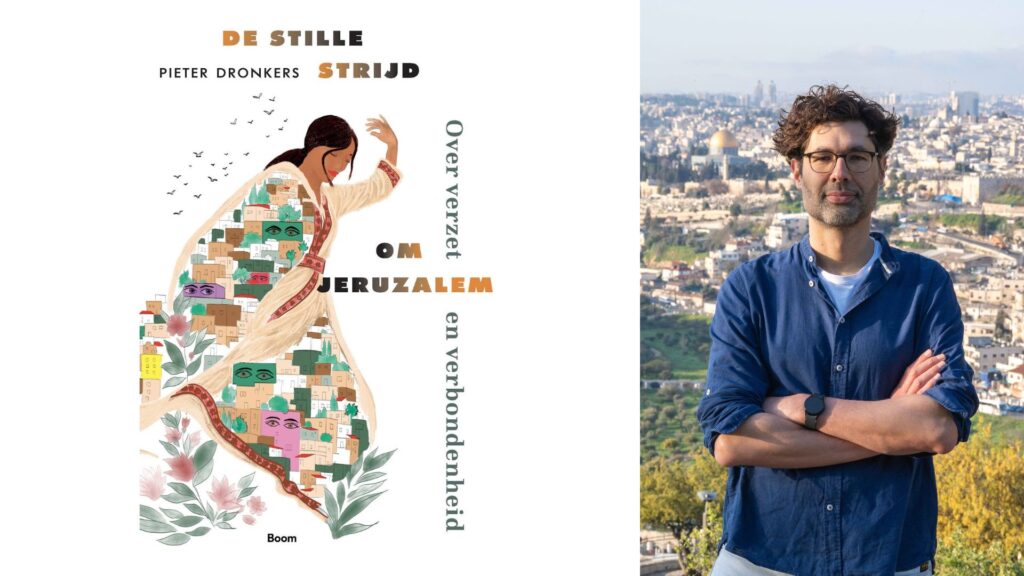
Publication: De stille strijd om Jeruzalem | Dronkers, Pieter | 9789024421930 | Boom