Bearing Witness Exhibition: Testimonies of Life during and after the War
The exhibition ‘Bearing Witness’ brings together the work of artists from (post-)conflict zones with the stories of Dutch veterans. The exhibition has been curated by PhD candidate Laura Mudde of the University of Humanistic Studies, following research into moral injury amongst veterans. The exhibition has been well received. The works are on display in Den Bosch until 30 March and in Arnhem until 20 April.
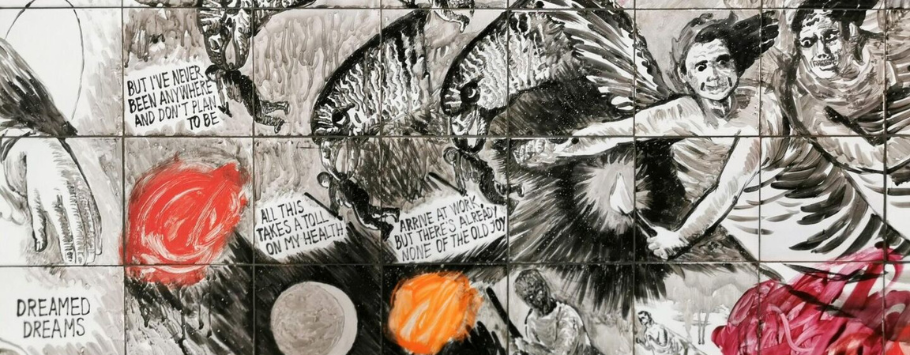
In ‘Bearing Witness’, the artists explore their memories of the conflict, their relationship with their country and the impact of (forced) migration. At the same time, it features stories from veterans who share their moral doubts about participating in various UN missions. Together, they demonstrate how events that may be historically defined continue to reverberate in people’s lives today. How situations ‘elsewhere’ are connected to here, and how one person’s perspective resonates with that of another.
The works and stories challenge us to transcend the boundaries of time, place and people, because denying that another person is just like you sows the seeds of violence. What does it mean, now, in a time of increasing conflict, to face up to these experiences? How do we bear witness, even when it is no longer comfortable to do so?
Bringing voices together
Curator Laura Mudde explains: “Together with Carmen Schuhmann from the University of Humanistic Studies, I conducted research into moral injury amongst veterans. When thinking about moral injury, the emphasis is often placed on the individual veteran’s struggle, whereas what the veterans’ struggle is really about is the interconnectedness between people. We wanted to highlight that in this exhibition. We wanted to bring together voices that are all too easily pitted against one another.”
“At the same time, it is also a personal statement, as a researcher. I found it unsettling to look back on wartime situations with veterans, whilst in some of those places the conflicts were flaring up again. I felt ‘frozen’ by the protests taking place — online and offline — which repeatedly emphasised that you are complicit if you do not speak out. I was searching for my own way to speak out. How can you contribute to non-violent coexistence without repeating the violent logic of ‘demarcation’ and ‘condemnation’?”
The exhibition took place at two venues:
- POST Arnhem (25 januari – 20 april)
- Willem Twee Kunstruimte Den Bosch (opening 8 februari – 30 maart)