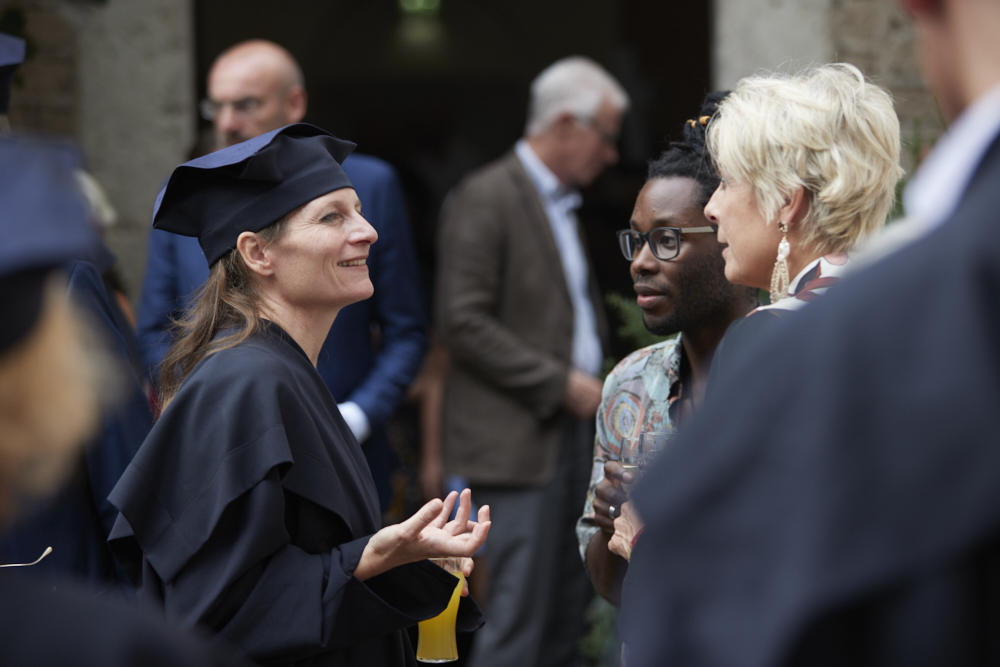


PhD Defence Chloé Roegiers Mayeux
Location: Geertekerk, Utrecht
On 23 April, Chloé Roegiers Mayeux will defend her thesis Fragmented Solidarities: on Female Survivors of Domestic Violence with a Migration Background in the Netherlands.
Summary
The research explored how gender-related cultural expectations shape the solidarity of institutions, families, and social workers, and how these forms of solidarity influence women’s choices. It is based on the experiences of ten female survivors of domestic violence with different cultural backgrounds and thirty-seven social workers assisting this group. Rather than examining isolated influences, the study highlights how gender-related cultural expectations, migration histories, and structural conditions interact to affect whether women leave, remain in, or return to abusive relationships.
An analysis of Dutch policy reveals that the intersection of domestic violence and migration regulations can produce discriminatory outcomes, especially for women with dependent residence permits. Factors such as insecure residence status, language barriers, social isolation, and dependence on their partner can limit access to support services. At the family level, the study identifies an ambivalent but crucial role. Although cultural norms may discourage separation, family support can be decisive in enabling women to leave abusive situations, and may shift from resistance to solidarity over time.
Social workers play a key role in fostering supportive networks and ensuring safety. The study shows that their social identities, especially gender and cultural background, influence their professional practice in both positive and challenging ways: shared identities can build trust but may also create tension, requiring reflexive strategies. Looking from a different angle, an important ethical dilemma arises when women consider returning to abusive partners, as social workers must balance respect for autonomy with responsibility for safety; Roegiers Mayeux argues for more room for active intervention in such cases.
In conclusion, the findings demonstrate that gender-related cultural expectations are important but not decisive on their own. Instead, the dynamics of solidarity across institutional, familial, and professional contexts shape women’s agency, showing that support systems can both constrain and expand their options.