Social support and post-traumatic stress in high-risk occupations
Some professionals, such as police officers, firefighters, and paramedics, are almost daily exposed to potentially traumatic experiences. Social support can be an important protective factor against developing symptoms. However, this does not work in the same way for every profession, discovered psychologist Renate Geuzinge. On January 28, 2026, she defended her dissertation Horizontal versus vertical social structure of high-risk occupations: the role of the social environment in the risk of traumatization at the University of Humanistic Studies.
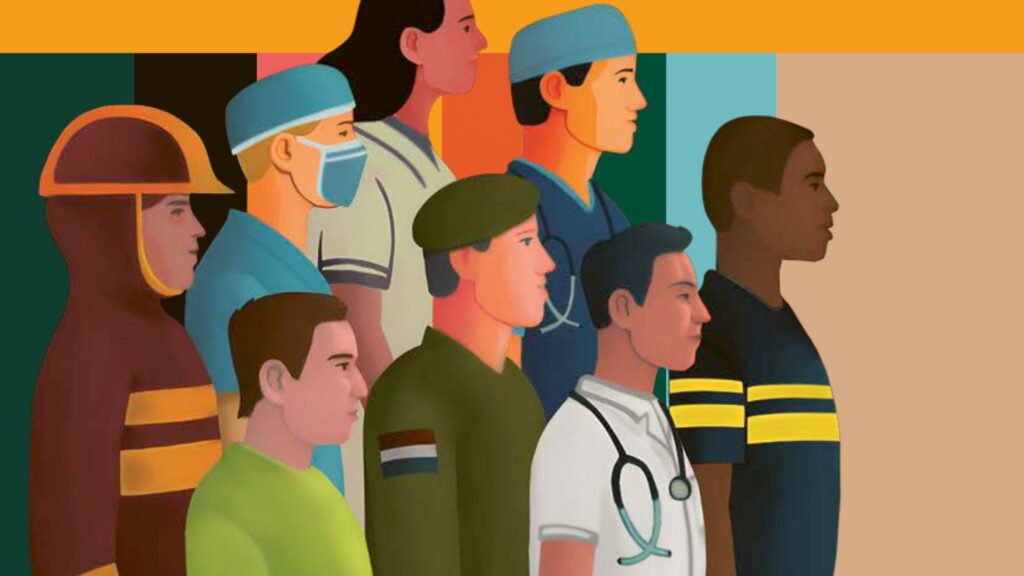
Professionals in so-called high-risk occupations are trained to remain calm and suppress certain emotional reactions during moments of crisis. Later, this can still lead to symptoms. Approximately one in five first responders in such occupations experience symptoms of post-traumatic stress. There is evidence that social support is an important protective factor against developing post-traumatic stress disorder (PTSD), but much remains unclear about how it works exactly.
Social environment
Renate Geuzinge investigated the role of the social environment in the risk of traumatization across different high-risk occupational organizations. She conducted ethnographic research with police, fire services, military, and ambulance services, as well as in emergency rooms, operating rooms, and intensive care units of hospitals. She identified two different social structures. It is important to take these differences into account in prevention programs and trauma therapies, according to Geuzinge.
Police, fire services, and military have a predominantly vertical social structure. Professionals within these organizations form family-like, hierarchical connections, primarily within their organization. Group unity and a clear ‘us-versus-them’ mentality are emphasized. These strong bonds, especially with superiors, can be protective, but they also create vulnerability. When relationships within the organization become a source of stress, or when the professional leaves the occupation, the important protective factor against PTSD disappears and the risk of mental health problems increases.
Vulnerability
This contrasts particularly with voluntary firefighters, paramedics and nurse anesthetists, who, like most other occupations in society, that have a more horizontal social structure. They also value individuality and autonomy more, and there is less of an ‘us-versus-them’ mentality. They form broad social connections within society; they move in multiple groups simultaneously. This makes them less vulnerable. If support from one group falls away, there is still support from another.
The social structure also influences how professionals emotionally relate to patients and/or civilians. Professionals in a vertical social structure are susceptible to experiencing unexpected moments of identification with victims, when the ‘us-versus-them’ boundary suddenly dissolves during an incident. These moments can trigger intense emotional distress, increasing the likelihood of trauma-related mental health problems. These effects are stronger when professional socialization occurred during the formative adolescent years.
Renate Geuzinge is a psychotherapist and clinical psychologist, specialized in chronic traumatization.
See also: https://research.uvh.nl/en/persons/renate-geuzinge/publications/
Thesis: Renate Geuzinge, Horizontal versus vertical social structure of high-risk occupations: the role of the social environment in the risk of traumatization, ISBN/EAN: 978-94-6473-998-5